What Happened When I Tried to Lead Like Jack Welch
I adopted the Welch leadership style and it nearly ended my career. On why another leader's playbook is a costume, and how to grow as yourself instead.
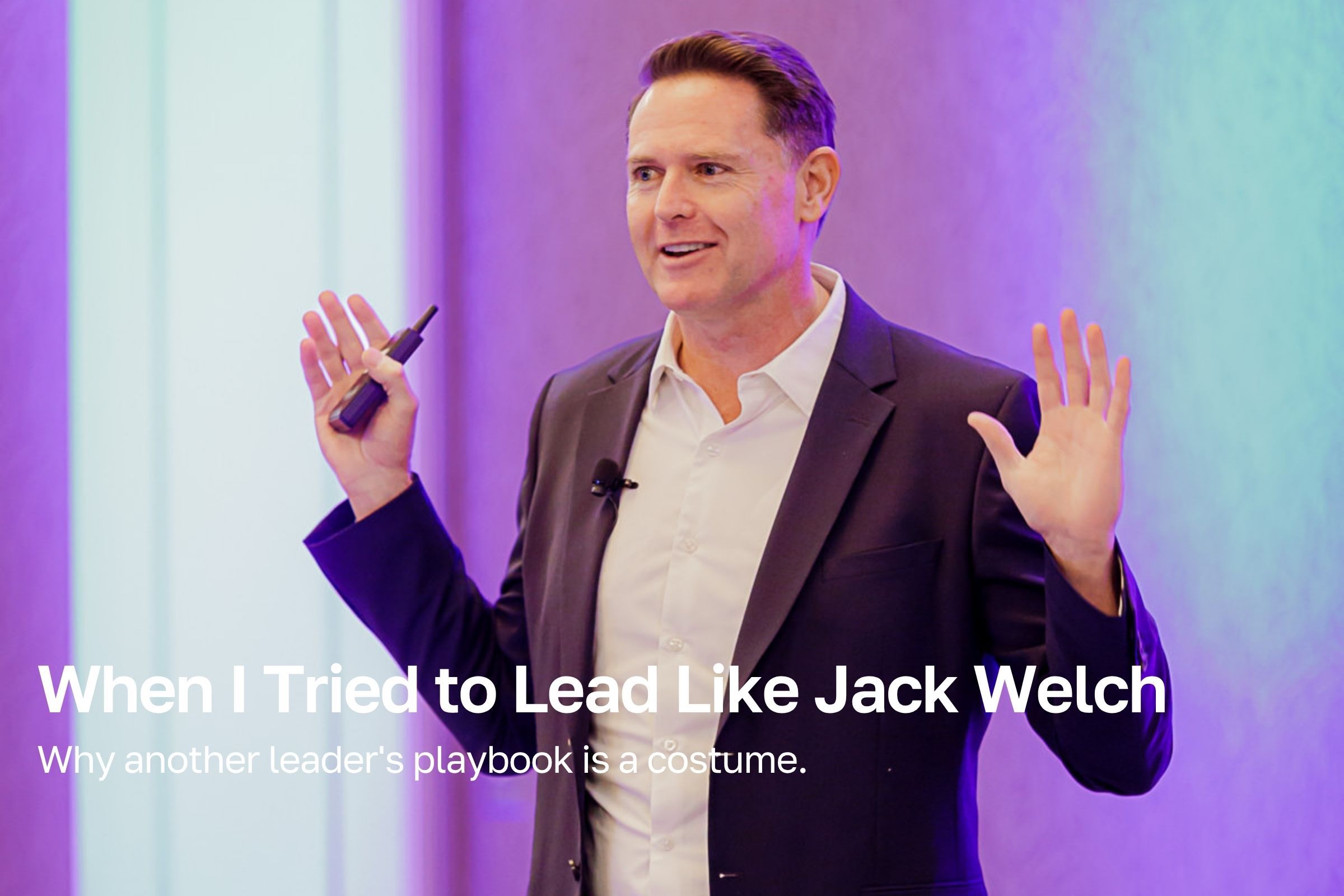
The first sign was a conversation I did not expect. A colleague I trusted told me I had become too harsh. Not demanding. Harsh. Around the same time, my wife and daughters started seeing a side of me at home that none of us recognised. I had not changed companies, changed roles, or changed teams. I had changed leaders. I had decided to lead like Jack Welch, and it was costing me everything I was actually good at.
Why did an entire generation want to lead like Welch?
Because for two decades, almost nobody said otherwise. Go back to the years when Welch ran General Electric and you will struggle to find a disparaging word about him. He ran one of the world's great conglomerates, delivered the numbers Wall Street wanted, and presided over Crotonville, arguably the most celebrated leadership factory in corporate history. His rule that GE would compete only where it could be first or second in a market became a template for businesses everywhere. He wrote a book and called it Winning. Who does not want to win?
I studied all of it. I leaned into the GE Workout approach, with its structured, time-bound, employee-driven results. I read the earnings transcripts. I absorbed the mythology the way an ambitious operator charging up a career path absorbs anything that promises an edge.
But one thing never sat right. I could not reconcile how he got his results with the results themselves. There was a ruthlessness in the style, a public callousness about people, that ran against everything I believed made me effective. My approachability was a genuine strength. I took the time to care, to listen, and then to make the call that moved things forward.
So I asked myself the question that would cost me dearly: if I wanted Welch-like results, did I need to become more like Welch? More hard-core, less accessible, more dictator than collaborator? Did I need my people competing against each other rather than for each other?
I was not certain. But I was eager to grow, so I experimented.
What happens when you wear someone else's leadership?
People notice immediately, and what they notice is not improvement. It is impersonation.
I was told the new intensity was unhealthy. I felt more imposter syndrome than at any point in my career, and I walked into meetings nervous that had never made me nervous before. That last detail is worth sitting with. The borrowed style was supposed to make me more formidable. Instead it made me fragile, because I was now performing a role rather than exercising judgment. Every room became a stage, and a stage is an exhausting place to make decisions.
The results did not come either. This was supposed to be the trade: discomfort in exchange for performance. There was no trade. In my quest to be greater for my team, I let people down, and I let myself down. My health suffered. My reputation suffered. I had compromised my own principles in pursuit of someone else's, and I eventually left the company in what I can only describe as a come-to-Russell moment. It took me a long time afterwards to restore my sense of who I was as a leader.
Was the problem Welch, or was the problem me?
Both, and the second matters more, because it is the one you can control.
History has since caught up with the first. David Gelles' reassessment in The New York Times, drawn from his book The Man Who Broke Capitalism, makes the case that the Welch method damaged GE and much of corporate America along with it. And the record of his proteges tells its own story. Robert Nardelli carried the playbook from GE to The Home Depot, and Wharton's post-mortem on that tenure reads as a blueprint for failure. I spent about a year consulting at The Home Depot's Atlanta headquarters during the Nardelli years, and I sensed some of that devastation first-hand. The method did not travel. It barely survived contact with a different company, let alone a different person.
But the deeper lesson is the second one. Because a leader delivered great results by doing something, it does not follow that the something is a playbook for you. Read that sentence again. Results are an outcome of a person operating in a context. Strip out the person and the context and what remains is not a method. It is a costume.
How do you lead as yourself and still get better?
Start by finding out what you are actually like to work for. At least once a quarter, answer this question honestly: what is it like to be on the receiving end of you? Then write down your philosophy of leadership in a sentence you would say aloud, and the values, in priority order, that you will exhibit and expect from your teams. If you cannot articulate these, you are leading by default, and a leader without a stated philosophy is the easiest person in the world to talk into someone else's.
Then grow deliberately rather than imitatively. Acknowledge where you fall short and build those skills constructively, or surround yourself with people who carry what you lack. Contrary to the mythology, great leaders do not have to be great at everything. What they do have to do is hear the truth, especially about themselves, which is hard in hierarchy-heavy environments and is no excuse for not doing it.
And pay attention to how your actions feel. If the answer to "does this feel right?" is anything short of a resounding yes, pause and ask the people around you for counsel. Leaders ask for counsel. That was true before Welch, and it survived him.
Being a better leader comes from being a better person. Refine, grow, sharpen your edge. But do it as yourself, because the moment you become someone else, the people who trusted you can no longer find the person they agreed to follow.
FAQ
Was Jack Welch actually a bad leader?
He delivered strong financial performance at GE for two decades, and that achievement is real. The reassessment concerns the cost: the culture his methods created, what happened to GE after him, and the damage done by companies and leaders who copied the style without the context.
Why does copying another leader's style fail?
Because results come from a person operating in a specific context, and neither transfers. When you adopt a style that is not yours, your people sense the impersonation before you do, and you lose the credibility that made you effective in the first place.
How do I improve as a leader without imitating someone else?
Study other leaders for understanding rather than for imitation. Ask regularly what it is like to be on the receiving end of you, write down your own philosophy and values in priority order, and close your gaps by building skills or by surrounding yourself with people who carry them.