The Lessons Nobody Outside a Big Consulting Firm Ever Sees
A tiny fraction of applicants ever get inside a top consulting firm, which means almost nobody sees how the model really works. Here is what over a decade inside taught me about reputation, depth, and the one asset that belongs to you rather than the firm.
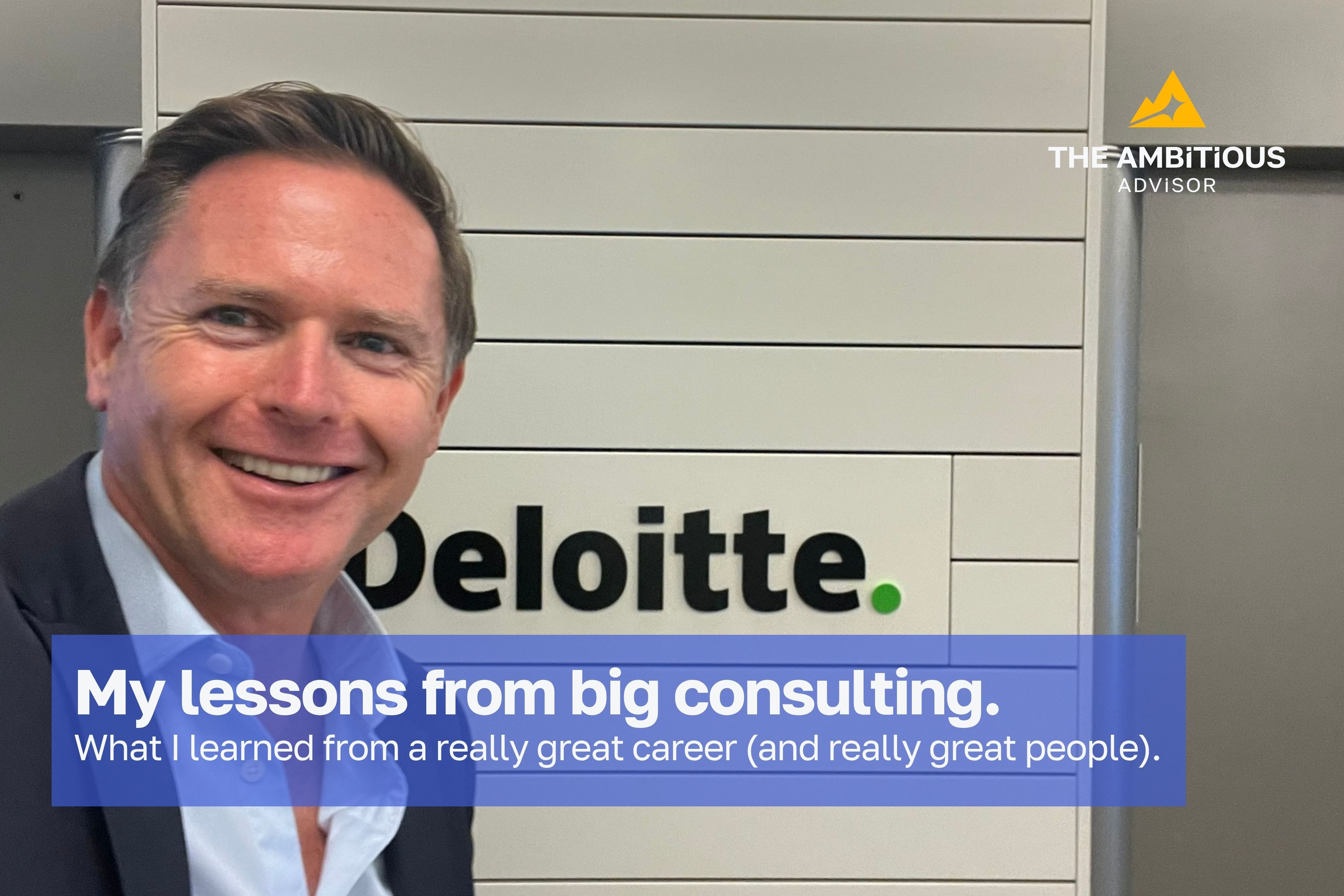
Deloitte is right up there as one of the top consulting firms in the world. The only problem is that every year they hire a tiny fraction of the people who apply, which means that unless you are one of the lucky few who gets in, you never get to see how those consultants actually go into their clients and work on some really meaty challenges (certainly not from the consultant's side of the table.)
I started my career in consulting in Africa working in process engineering in gold mines, engineering firms, and fish-processing plants. I then moved to New York and worked for Deloitte Consulting for over twelve years. After that I ran the consulting business for Dr John Kotter of Harvard Business School, and today I run my own consulting business full time. I have also spent time in industry, on the other side of the consulting relationship, where I was the one hiring the consultants.
So over the next few minutes I want to teach you what I learned about how the big firm model is really built, what clients are actually paying for, and the kind of work that grows an advisory business. There were plenty of lessons on how to build a client-ready deck, how to network, how to run structured problem solving. Those are predictable. What I want to share are the less predictable insights, the ones that took me years to figure out the hard way.
How the firm actually works
Inside any consulting firm there are at least two power maps you have to learn to read.
The first is obvious. It is the org chart. It shows who makes the decisions and who runs the place. The second is never written down, and it is the map of who has influence with the clients. When the client is paying the bill, who they trust matters enormously. These two maps coexist, and they often point in very different directions, because the org chart is about who the firm values, and the unwritten map is about who the client values.
The people who understand this fast (who work out whose opinion actually moves a decision) are the ones who get pulled onto the next engagement and the one after that. And here is the part that surprised me: the consultants who were genuinely exceptional on the client side - the ones clients asked for by name - only ever appeared in internal leadership roles for a fleeting moment. They cycled in and they cycled out, not because they lacked ability, but because they chose to add value to clients over building internal visibility. So the real work goes beyond being good at what you do. Being known by the right people, for the right reasons, is the single biggest career accelerator in consulting.
Which raises the obvious question. Known for what?
Reputation is three things, not one
Most people think reputation is a single thing. It is not. In consulting it is three distinct things, and understanding the difference should change how you show up from day one.
- Technical expertise and competence. The knowledge you have, your ability to think around corners and solve a problem in a way that genuinely adds value. This is the one everyone focuses on, and it is what makes clients want you back, which means revenue for the firm.
- Work ethic. Whether you do what you say you will do, and whether people can rely on you. A project manager messages you on a Tuesday afternoon with a question that needs a real answer. You do not have it yet, so you have two choices. You get to it when you get to it, because you have a hundred other things on, or you reply straight away, give an estimated time, and then deliver on it. The people who manage that well build a reputation for being dependable, and dependability becomes their currency.
- Relationship skills. How you carry yourself with colleagues and clients, especially when the work is hard or the message is uncomfortable, because sometimes it will be. Likeability has always beaten being clever, and in a relationship business, being someone others want to work with is its own form of capital.
Here is what surprises people. You can have two of these from day one. An analyst has not solved the hairiest problems yet, so the technical expertise is not there. But work ethic and relationship skill are available immediately, whatever your level. Over time the technical depth compounds on top, and the consultants who had all three were basically untouchable. We all competed for them. That combination is rare, it is the single most important asset you can build in consulting, and it is not something anyone can easily take away from you.
The matrix, and where you choose to play
There is a dimension here that felt very different from my time in industry, and it is the matrix.
Most big firms are organised as a complex matrix. On one axis you have industry verticals, financial services, energy, consumer, government. Think of it as where you work. On the other you have service lines, strategy, human capital, technology. That is what you do. Almost every consultant sits at an intersection of the two, and one of the most defining decisions you will make is where you choose to play. Are you building towards being an industry expert, or a solutions expert? That choice shapes your trajectory inside a big firm more than almost anything else.
When a client has an issue, they hire a consultant based on evidence that the consultant has solved that same problem before. Not a similar problem, not an adjacent one, the same problem. If you have helped a banking client solve a client attrition problem, another banking client finds that immediately credible. The context is familiar, the language is familiar, the risk of hiring you feels lower. But walk into that same banking client and talk about the equivalent work you did in manufacturing, and most sophisticated buyers will hesitate. Not because the work is that different, but because they do not want to be the client where you learn their industry. They are paying you to already know it. So the more precisely you can connect your expertise to an industry's real challenges, the more compelling you become, and the less you have to compete.
Where you have real depth
This takes me to a lesson I was slower to learn than I would like to admit. It is about the knowledge you actually bring into the room.
The best consultants I worked with all had one thing in common: they had a zone of genius, a specific domain where they were genuinely the expert, where their depth meant they could think from first principles and go second and third order on anything the client threw at them. And they were disciplined about staying inside that zone. Think about it like this: if you have knee pain, you go to a knee surgeon, not a heart surgeon. And if you did walk into a heart surgeon's office with a sore knee, you would hope they would say, that is not what I do, but here is who you should see. Most of us would respect that answer. We might even trust the heart surgeon more, not less, because of it.
But what I see a lot of consultants do, especially those just building their own business and desperate for traction, is take work they have no right to take, work that is not in their zone. How do I know? Because I have done it myself, twice. In both cases it was a client I had done great work with, who came back asking for help on something adjacent. Not quite what I do, but in the ballpark. I said "yes" both times. The clients did not have a bad experience, and the results were not bad, but I felt it. I felt like an impostor, and the performance was not great. I had to control the conversation, manage its breadth and depth, because it was not a deep application of knowledge, it was shallow. When you are inside your zone, you do not have to control anything. The client can take the conversation wherever they need it to go, and that is what good looks like.
That distinction between superficial knowledge and real depth is everything, and it matters most in advisory work. Implementation is one thing. But to advise, you have to know more than the client, because that is what they are paying for. Second and third order thinking, first principles, seeing what they cannot see. That only happens when you are genuinely inside your zone.
The insecure overachiever
I will say upfront, this was me. There is a profile that thrives in consulting, and you have either met them or you are them. Relentlessly capable, always prepared, first to volunteer, last to leave. There is a term for it that sounds almost like a compliment. The insecure overachiever.
Here is what makes it work as a machine: That insecurity is not a flaw the firms tolerate, it is a feature they select for, because an insecure overachiever does not need to be managed. They manage themselves. The anxiety of not being enough drives them to become more than enough, and the output is extraordinary. But the cycle never closes. You perform to earn approval, you earn it, and instead of the approval resolving the insecurity, it resets it, because now the standard is higher. The next engagement is more complex, the next client more senior, and the question you have been quietly dreading just got harder to answer.
For me that question was simple: I was always waiting for a client to ask, "have you actually ever done this? Not advised on it, but done it, lived it, made the decisions with your own budget and your own career on the line." The honest answer was no. So I did something unusual. Despite a successful career, I left Deloitte Consulting and joined Bank of America, specifically to answer that question from the inside.
Here is what I learned: the insecurity was real and rational, and the gap was real. But it was pointing at the wrong problem. The question is not whether you have done it before. The question is whether you understand the terrain well enough to navigate a client through it, and whether you are honest enough to know when you are at the edge of what you know. The best consultants I have ever seen do not convince clients they have all the answers. They make the client feel safe enough to work through the uncertainty together.
The right shape, and why your depth is the key
If you have to stay narrow, how do you build a career? Do you not eventually run out of clients who need that one thing?
This is the lesson that took me longest to appreciate. Inside the firm I watched it again and again. The people who became known for solving one specific problem, really solving it, got deployed across more clients than anyone else. We would land a new engagement and immediately chase staffing to get the one person who had done this thing before, because they knew the problem and they knew the solution, and solving that problem is what we had been hired to do. The firm monetises how good you are at one thing by taking you to client after client after client. And along the way you learn that the specifics of any one client matter less than the specifics of the problem itself. Back to our analogy: A knee in China is the same as a knee in South America. The patient is different, the language is different, the whole system around the patient is different, but the knee is the knee. Understand it well enough and geography stops mattering.
There is a trap on each side of this, though. Too narrow and there is no market; you cannot be the surgeon who only does knee surgery for twelve-year-olds in Madrid, there simply are not enough of them. Too broad and you become a generalist for hire, generally useful and specifically unremarkable, and that is when you start competing on price instead of authority. The right shape is specialist enough that you are genuinely the authority on something, and business-literate enough to have a proper conversation with your client about how they make money and what is getting in the way. Get that shape dialled in and your confidence changes, which changes how you show up, which changes the work itself. Better results, better referrals, better clients, and it compounds in a way that broad generalist work simply cannot.
And once you have spent years being deployed across clients because of that one thing, you start to realise something. The thing the firm has been renting from you, that specific depth, does not belong to the firm. You built it, you carry it, and you can take it anywhere.
If a solo consulting practice is something you are seriously weighing, I have built a simple model that shows the maths behind it, the realistic capacity, the realistic prices, and what a solo practice actually looks like at half a million, three-quarters of a million, or a million in revenue. It is free, and you can work through it here.
Two models, and the question only you can answer
Almost every consultant I have met in a big firm has thought about doing it themselves. Once you understand that your asset is the problem you solve, the natural next thought is, "how do I build a business around this?" And this is where the model, big firm or solo, really starts to matter. These are not better or worse paths, they are different ones, and confusing them is one of the most expensive mistakes I see people make when they leave. It costs them years, revenue, and some of their reputation.
The partnership model is essentially an equity model. As a Partner, you buy into the firm, and that buy-in gives you a share of the performance, which is great in a good year and leaner in a poor one. You sell, you grow your revenue so you can invest in the firm and fund the resources the firm has (employees, real estate, etc.) It rewards people who like increasing responsibility, because as you climb, your sales targets grow and so does your share of the result. Or of course you could be an employee, hired at will, to be charged out to clients. The people who thrive at a big firm want that scale and that breadth, and they are comfortable dealing with a lot more than the client work. For some, there is a great deal to like in that. The big consulting firm is a real product, and a genuinely good career for a lot of people. According to Statista's 2026 Consulting Industry report, these firms collectively service a market worth well over $300 billion a year, and clients would not spend that if they were not getting real value. Some genuinely need the breadth, the ability to call one firm and have them handle everything.
The solo consulting business is a completely different shape, built for a different person. It is for people who have developed a deep, focused skill and solve one problem better than almost anyone. They do not want the headcount, the politics, or the obligation to keep growing to feed an ever-larger sales target. They want to work directly with clients on the problems they love solving, and be paid well for it because they deliver results. In my own case, larger firms have approached me about acquiring the business I have built, not because of its size but because of its depth. What I have built is complementary to what they offer - they have breadth, I have depth, and a solo practice that does depth exceptionally well can become an acquisition target precisely for that reason.
So the deciding factor between the two paths comes down to self-knowledge. Do you want to lead a growing practice, carry the sales pressure, and build something at scale? Do you want the security and the variety of being part of a large firm? Or do you want to be the deepest expert on one specific problem and let that depth speak for itself? These are all genuinely good choices. They are just different ones, built on different assumptions about what you want your working life to look like.
If I have to leave you with one thing, it is this. Get really good at understanding the problem you solve, and become the very best at solving it. That is what makes you successful, whether you stay inside a firm or build your own.
Common questions
What is the difference between advisory work and implementation work?
Implementation is doing the work. Advisory is knowing enough to guide someone through a decision they own. Advisory demands more depth, because you have to see what the client cannot, and that only holds up when the problem is genuinely inside your zone.
How narrow is too narrow?
Narrow enough to be the authority, broad enough that a real market exists. The knee surgeon works. The knee surgeon for twelve-year-olds in one city does not. If you cannot picture enough clients to sustain a business, you have gone too far.
Can I really take my expertise with me when I leave?
Yes. The depth is yours, not the firm's. What the firm charged out to clients was your ability to solve one problem well, and that travels. The mistake is assuming the firm's business model travels with it, because it does not.
Is the solo path better than the partnership path?
Neither is better. They are different jobs built for different people. The partnership rewards those who want scale and can carry a growing sales number. The solo practice rewards those who want depth and direct client work. Choosing well is a question of self-knowledge, not ambition.
If you would rather build the solo path than wonder about it, The Lab runs across five days, one hour a day, and we work through the shape of your own practice so you leave with it taking form.
Read the transcript
Deloitte is right up there as one of the top consulting firms in the world. The only problem is that every year they hire only a tiny fraction of the people who apply, which means that unless you're one of those lucky few who gets accepted, you won't get to see how those consultants go into their clients and work on some really meaty challenges. Certainly not from the consultant's side.
I started my career in consulting in Africa. I then moved to New York and worked for Deloitte Consulting for over twelve years. After that I ran the consulting business for a leading Harvard Business School professor, and today I run my own consulting business full-time. I've also spent some time in industry on the other side of the consulting relationship, where I was the one hiring the consultants. I'll get to that in a minute, but in the next fifteen to twenty minutes I'm going to teach you everything I learned and all the insights I had about consulting, from how the big firm model is really built to what clients are actually paying for.
We'll talk about the difference between advisory work and implementation work, and the kind of work that really grows an advisory business. Of course, there were loads of lessons on how to build an impressive client-ready PowerPoint deck, or how to network effectively, how to approach structured problem solving, or understanding firm economics. Lots of technical insights, but those are pretty predictable. What I want to share with you are the less predictable insights, and my hope is that they'll save you the years that it took me trying to figure this all out the hard way.
Let's start with insight number one, and this one makes all the difference as you're trying to grow and navigate your way around a firm like Deloitte. I loved my time at Deloitte. We did some amazing work, and the friends that I made then are still some of my very good friends today. Being a part of a leadership team, building a business, hiring people, doing great work, it was all fantastic. But I learned that inside any consulting firm there are at least two critical leadership dynamics and power maps that you need to navigate.
Now, the first is pretty obvious. It's the org chart. Basically, who makes the decisions and who runs the place. And then there's the second one. It's really not written down, and it's the map of who has influence with the clients. Honestly, when the client is paying the bill, who has influence with a client is hugely significant. Now, these two maps, they coexist. If the first one is about positional power, well, the second one is much more about authority and influence. And while there can be some overlap, they often point in very different directions, because the org chart is all about who the firm values, and the unwritten map is all about who the client values.
When it comes to being successful in consulting, the people who figure this out fast, who understand who matters, they're the ones who are going to be successful, because they're going to figure out how to get pulled onto the next engagement and the one after that, and where to put their effort and where to put their time. The firm's map determines whether you get an internal leadership role or some advancement opportunity. The client's map determines whether you stay on the engagement. They're not the same thing, and confusing them, or not seeing the difference, can be a career-limiting stumble.
But here's the insight that actually surprised me. The consultants who were genuinely exceptional on the client side, the ones the clients requested by name, if they appeared in firm leadership, it was only for a fleeting moment. They cycled in and they cycled out, not because they lacked ability. Quite the opposite, actually. They just prioritised adding value to clients over building internal visibility and dealing with everything that it took to run a business.
So if you're building a career in consulting, the real work goes beyond being good at what you do. The real work is figuring out fast whose opinion actually moves a decision, who the clients trust, who the other partners trust. Because being known by the right people for the right reasons is the single biggest career accelerator in consulting.
And this sets up the next insight. Because once you understand that being known matters more than knowing people, the obvious question is, be known for what? And think of this as your reputation. In consulting, your reputation is everything. It determines which engagements you get pulled onto, who wants to work with you, and ultimately how successful you're going to be. I've seen people with real talent, real potential, fail because of this one dimension, reputation.
Now, here's where most people get it wrong, though. They think reputation is one thing. But it's not. In consulting, like so many other areas, it is three distinct things. And understanding the difference between them should change how you show up from day one.
The first dimension is about your technical expertise and your insights. The knowledge you have, the wisdom you've built up, your ability to think around corners and solve problems in a way that really adds value for a client. This is the dimension that everyone focuses on, especially as they become more senior. It's the technical competence that makes clients want you back. And when clients want you back, that means revenue for the firm. And the ultimate measure of success is revenue.
The second dimension is your work ethic, how you show up, whether you do what you say you're going to do, and whether people can rely on you. For instance, a project manager messages you with a question on a Tuesday afternoon, and it requires a substantive response. Now, you don't have the full response, so you have two choices. The one is you get to it when you get to it, you've got loads of other things going on. And the other is to reply immediately, give an estimated response time, and then deliver on time. Now, those people, the ones who proactively manage the time and the response, and then they deliver, they're building a reputation that says they are dependable and reliable, and dependability and reliability become their currency.
The third dimension of your reputation is your relationship skills. How you carry yourself with colleagues and with clients, especially when the work is hard or the message is uncomfortable, because at times it will be. Likeability has always beaten being smart, and in a relationship business, being somebody that others genuinely want to work with is its own form of capital.
Now, here's the part that surprises people. You can actually have two of these from day one. An analyst doesn't have years of work experience behind them. They haven't solved the hairiest of problems. So they don't have much in the way of technical expertise. But they absolutely can have a reputation around work ethic from day one. So that's two of the three dimensions of reputation available immediately, regardless of how senior or how junior you are. And over time, as your career continues to compound and grow, you will grow the technical expertise, and then you'll have all three. Those consultants who had all three were basically untouchable. We all competed for them. Clients would want them, peers and colleagues wanted to work with them. That combination is rare, and I would suggest that this is the single most important professional asset that you can build in consulting, and it's not something others can easily take away from you.
But there's another dimension that I found very different to when I worked in industry, and it's all about the matrix. See, most big consulting firms are organised as a very complex matrix. On one dimension, you have industry verticals, financial services or energy, consumer, government, technology. Think of it as where you work. On the other, you have service lines or service areas like strategy or human capital, transaction services or technology. This is what you do. Both of these dimensions have leadership structures and growth targets. They're generating white papers and IP. They overlap everywhere. What this means, though, is that almost every consultant is sitting at an intersection point. You belong to an industry and you belong to a service area, and one of the most defining decisions that you will make is where you choose to play. Are you building towards being an industry expert, or are you building to be a solutions expert? That decision will shape your trajectory inside a big firm more than almost anything else.
So what should you do? Well, here's the principle that I live by and perhaps could guide your decision. When a client has an issue, they hire a consultant to solve that issue based on evidence that the consultant has solved the same problem before. Not a similar problem or an adjacent problem, but that same problem. Now, if you've helped a banking client, for instance, solve a client attrition problem, another banking client is going to find that immediately credible. The context is familiar, the language is familiar, the risk of hiring you feels lower. But if you walk into that same banking client and say you have done similar work in manufacturing, for instance, most sophisticated clients are going to hesitate. Not because the work is necessarily that different, but because they don't want to be the one where you learn their industry. They're paying you to already know it.
So what does this mean practically? Well, you want to eradicate that hesitation. Inside the matrix, the most senior client-facing partners were almost always industry deep. They had spent years inside one vertical, building relationships, learning the language, understanding the regulatory and the competitive environment and all the pressures that those clients faced. They were genuine peers with their clients, and that peer relationship is what set them up to generate revenue. The implication for you is this. The more precisely you can connect your expertise to an industry's real challenges, the more compelling you become. And the more compelling you become, the less the client hesitates and the less you have to compete.
This brings me to the next insight. And there's a piece about this that took me a lot longer to learn than I'd like to admit. It's all about the work product dimension of reputation. Specifically, that knowledge that you bring into the room. The best consultants I worked with at Deloitte all had one thing in common. They had a zone of genius, a specific domain where they were genuinely the expert, where their depth of knowledge meant that they could think from first principles, where they could go second and third order on a question with a client, anything that the client threw at them, and they were disciplined about staying inside that zone.
You think about it like this. If you have knee pain, you go to a knee surgeon. You don't go to a heart surgeon. But if you did walk into a heart surgeon's office with a sore knee, we hope that the heart surgeon would say, that's not really my area, it's not what I do, but here's who you should see instead. And most of us would respect that answer. We'd respect the referral, and we might actually trust the heart surgeon more, not less, because of it.
But what I see a lot of consultants do, especially consultants who have just left or are thinking about building their own business, they're desperate to build their business, to get traction, get revenue, and frankly get the work. So they take work they really should not take, that's not in their zone of genius, work they have no right to take. Well, how do I know this? Well, because I hear a lot of former consultants wrestle with this, and because I've done it myself, twice. In both cases it was a client who trusted me. We'd done some really great work together. They came back asking for help on something adjacent. Not actually what I do, but in the ballpark. And I said yes both times. The clients didn't experience a bad outcome, and the results weren't bad, but I felt it. Not only did I feel like an impostor, but the performance wasn't great. I couldn't let the conversation go where it needed to go. I had to control it more. I needed to manage the breadth of the discussion and the depth of the discussion, all of the outcomes and the points. It wasn't a deep application of knowledge. It was shallow and superficial. But when you're inside your zone, it just comes to you. You don't have to control that conversation. The client can take it wherever they need it to go. That's what good looks like.
This distinction between superficial knowledge and depth is everything. And it's especially the case in advisory work, which is different from implementation work. When it comes to advisory work, you have to know a lot more than the client, because they're paying you to advise them. And that means second and third order thinking, going back to first principles and seeing what they can't see. And that only happens when you're deeply, genuinely inside your zone.
There's something else I want to talk about here, and I'll say upfront, this was me. There's a profile that thrives in consulting. You've probably met them, or you are them. Relentlessly capable, always prepared, maybe even overprepared. First to volunteer, last to leave. They seem to have an answer for everything. And when they don't, they'll figure it out. They'll find an answer. And there's a term for it. It sounds almost like a compliment. Insecure overachiever.
Now, here's what makes it work as a machine. That insecurity isn't a flaw that the firms tolerate. It's actually a feature that they select for. Because an insecure overachiever doesn't need to be managed. They manage themselves. The anxiety of not being enough drives them to become more than enough. Every deliverable, every presentation, every client meeting becomes a chance to prove again and again that they belong at that table. And it works. The output is extraordinary.
But here's what nobody tells you about the insecure overachiever model. That cycle never ends. It never closes. You see, you perform to earn approval. You then earn the approval. And instead of the approval resolving the insecurity, it resets it, because now the standard is higher. The next engagement is going to be more complex. The next client is going to be more senior. And that question that you've been quietly dreading, the one that would expose you, just got harder to answer convincingly.
For me, that question was a simple one. I was always waiting for a client to ask me, have you actually ever done this? Not just advised on it, but done it, lived it, made the decisions with your own budget and your own career on the line. And the honest answer was no, I hadn't.
So that's when I did something unusual. Despite a successful career, I left Deloitte Consulting. I joined Bank of America in-house, specifically to answer that question from the inside, to know what it actually felt like to own a decision in a large, complex organisation. Here's what I learned, though. The insecurity that drove my performance at Deloitte was real, and it was rational, and that gap was real. But the insecurity was pointing at the wrong problem. The question isn't whether you've done it before. The question is whether you understand the terrain so well that you can navigate a client through it, and whether you're honest enough with yourself and your client to know when you're actually at the edge of what you know. The best consultants I've ever seen don't convince clients that they have all the answers. They're the ones who make the clients feel safe enough to work through that uncertainty together.
And this raises a fair question. If you have to stay narrow, how do you actually build a career? Don't you eventually run out of clients who need that one thing? Well, this leads us to the next insight, and it's probably the lesson that took me the longest to fully appreciate. Inside Deloitte, I watched this play out again and again. The people who became known for solving one specific problem, really solving it, ended up being deployed across more clients than anyone else. We'd all want them. We'd land a new engagement and we'd immediately get hold of staffing to see if we could get that one person who had done this thing before, because they knew the problem and they knew the solution, and solving that problem is what we had been hired to do.
Deloitte, like all the big firms, teaches you transferability by leveraging your depth, and the whole system monetises how good you are at one thing by taking you to your client, and then to the next client, and then to the next client who need that one thing. Along the way, you learn that the specifics of any one client matter less than the specifics of the actual problem itself. So going back to our knee analogy, a knee in China is the same as a knee in South America. The patient is different, the language is different, and the whole system around the patient is different, but the knee is the knee. And if you understand the knee well enough, geography doesn't matter.
But there's a trap on either side of this. If you're too narrow, you don't have enough of a market. You can't be the surgeon who only does knee surgery for twelve-year-olds in Madrid. That's too narrow. There just aren't enough of those clients to sustain a business. And on the other hand, if you're too broad, you become a generalist for hire. I like to say generally useful and specifically unremarkable. Now, not only does that not give you any differentiation, but that's where you start competing on price rather than authority, because there are a lot of people who are generally useful and specifically unremarkable.
The right shape is specialist enough that you're genuinely the authority on something, and you also have the ability to understand the context and to have a really good business conversation with your client about how they make money and what's getting in their way. You need to speak the language of business but bring depth to one specific problem inside that business. And when you have that shape dialled in, your confidence increases. That changes how you show up. It changes your work. It changes the quality of the work itself. You get better results and better referrals and better clients. And it compounds in a way that broad generalist work simply does not and cannot.
Once you've spent years inside a firm being deployed across clients because of that one thing, you start to realise something. The thing the firm has been renting from you, that specific depth, that problem-solving capability, it doesn't belong to the firm. It belongs to you. You built it, you carry it, and you can take it anywhere.
Now, if the solo expert practice is something you're seriously considering, I've built a simple model that shows some of the math behind it. It shows you the realistic capacity and realistic prices, and more importantly, what a solo practice could actually look like at half a million, three-quarters of a million, or a million dollars in revenue. It's completely free, and I've linked it in the description so you can get started and have a better understanding of what this would look like.
And that realisation sets up the last insight that I have on consulting. Almost every consultant I've ever met in a big firm, and certainly all of the consultants who have left big firms, have thought, can I do this myself, start my own business? The politics around having to work with some great people, but also a fair number of people who aren't pulling their weight, just becomes frustrating and annoying in a big firm. Once you've understood that your asset is the problem you solve, you start thinking, well, how can I build a business around this? And this is where the business model, big firm or solo firm, really starts to make a difference.
So the big firm partnership model, like Deloitte, is structurally brilliant for one kind of person, and the solo expert practice is structurally brilliant for another kind of person. Confusing the two, though, is one of the most expensive mistakes I see consultants make when they decide that they want to leave and build a career of their own. It costs them time. It costs them years in some cases, and it costs them revenue and partly reputation.
You see, the partnership model is essentially an equity model. You're invited to buy into the firm, and that buy-in gives you a share of the performance. Great in a good year, not so great in an off year. You're selling a lot, you're growing your revenue so that you can invest in the firm and pay for the support and the thousands of employees and offices around the world. It rewards people who like increasing responsibility, because as you climb, your sales targets get bigger, and so does your share of the results. The people who thrive at the top of a big firm are people that want that scale and want that breadth, that responsibility, and they're comfortable with dealing with a lot more than probably just the client work. It's a great model for those people. It's designed for the big firms, which collectively service a market worth hundreds of billions of dollars a year. Clients wouldn't be spending that money if they weren't getting some real value. Some clients need that breadth, that ease, the ability to call one firm and have them handle everything. And that's a real product, and the good firms have a reputation for delivering it pretty well.
But the solo expert practice is a completely different shape, and it's structurally better for a specific type of person. It's built for people who've developed a deep, focused skill. Those people solve one problem better than almost anybody else. They don't necessarily want the big headcount and the politics and the partnership pressure, the obligation to keep growing to feed an ever-growing sales target. They want to work directly with their clients on the problems they love solving and get paid really well for it, because they deliver results.
In my case, I've actually had larger firms reach out to me about acquiring the business that I've built. Not because of my size, but because of my depth. In those instances, what I've built, my IP and the work I do with my clients, is complementary to what they offer. They have breadth, I have depth. The solo expert business is great at depth, and depth on one problem. And those that do it well, really well, could become an acquisition target precisely because of that.
The deciding factor between the two paths, whether big firm or solo independent firm, comes down to a question of self-knowledge. Do you want to lead a growing practice, carry that sales pressure, and build something at scale? Or do you want to be the deepest expert on one specific problem and let that depth speak for itself? Both are great career choices. They're just very different ones, built on fundamentally different assumptions, different models, and different outcomes of what you want your working life to look like.
So those are the highlights of what I learned at Deloitte and from my career in consulting. It was an incredibly rich experience that I loved, with a set of lessons and insights around how to deliver work you're proud of that adds value to your clients. If I have to leave you with one thing, it's this. Get really good at understanding the problem you solve, and become the very best at solving it. That's what's going to make you successful, whether you're inside a firm or building your own.
Once you see the model for what it is, the next question is, what direction do you go in? Big firm or solo? So click this video here. I walk through how to set up a solo consulting business that's so good, your clients are going to be the ones chasing you. It's based on how I've built my business, and I'll show you the structure, the positioning, and the parts that can really separate you from the big firm. See you there.