The Generalist's Curse: Generally Useful, Specifically Unremarkable
Breadth feels like the safest play for an independent consultant. In fact it is a curse: generalists pay a preparation tax on every engagement, price by the hour, and deliver shallower work. The evidence, and the three moves that break it.
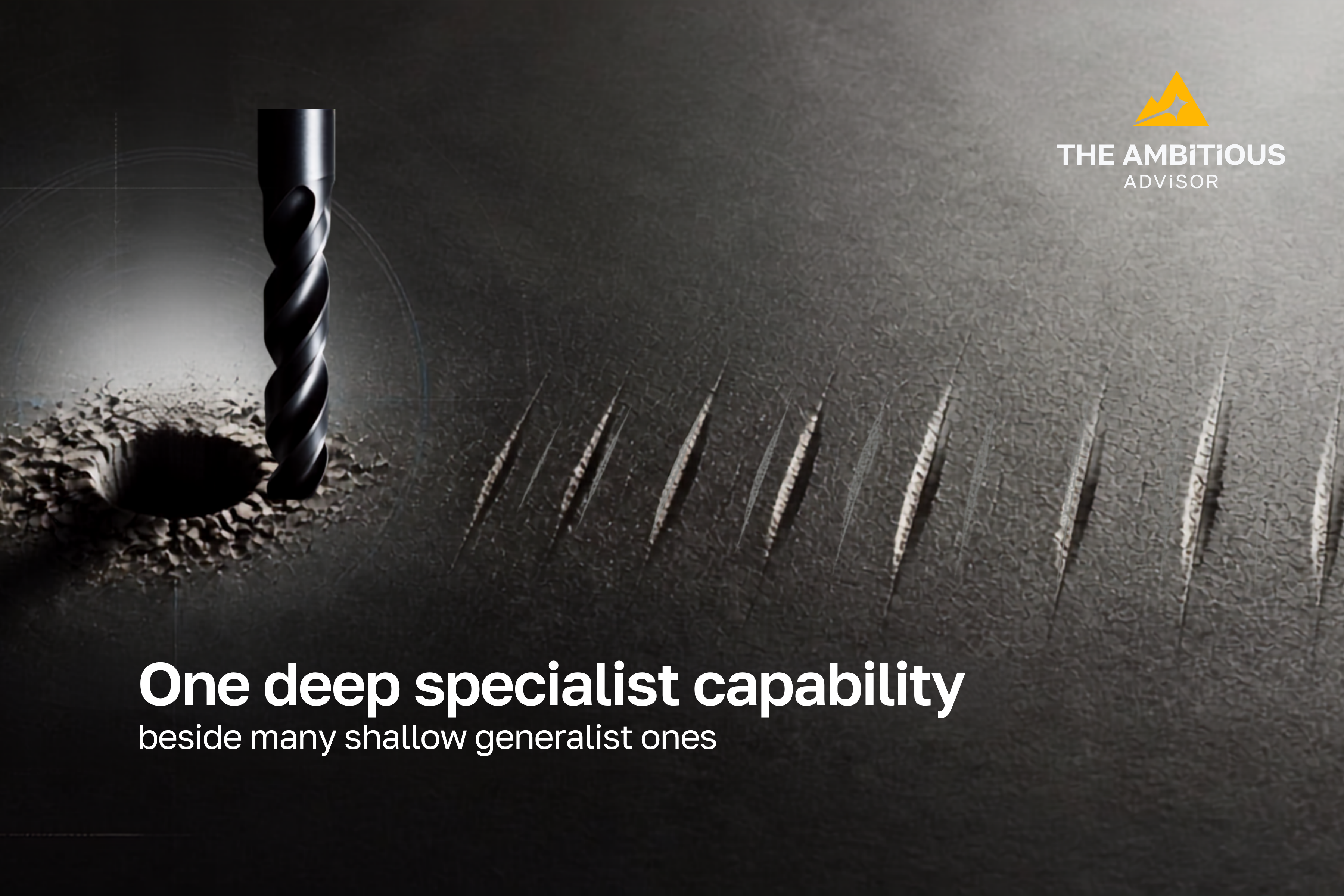
The client likes you. So when they ask whether you could also take a look at the pricing model, you say yes. Last quarter it was the operating review. Before that, a hiring plan. None of it sits in your sweet spot, but the relationship is warm, the money is good, and a warm client feels like the safest revenue in the world.
I know the move because I made it. When I went independent in 2021, I custom-built every engagement and took whatever work a friendly client would hand me. I told myself breadth was the prudent play. It wasn't. Instead it was the curse. When you are a generalist, you are generally useful and specifically unremarkable.
Why staying a generalist feels safer
Breadth feels safe because it turns warm relationships into revenue without any marketing. So it feels easy. A client who already trusts you will hand you adjacent work, and saying yes to them is far easier than finding a stranger who has the exact problem you solve best.
The logic runs like this. Selling is hard. This client already likes me. Therefore the cheapest path to the next SOW, your next deposit, is whatever this client will give me. Every independent consultant has run that calculation, and most of us have acted on it.
But look at what each "yes", what each new SOW, does. It pulls you one step further from your deepest expertise. You stop choosing your work, and your work starts choosing you, one accommodating engagement at a time. You start realizing that you're moving further from your core. And you start feeling a sense of unrest and uncertainty.
The fear underneath is real. Consultants who have made the shift will tell you that picking a niche feels like you're turning down and saying "no" to projects that could have been profitable. What the numbers say is more interesting. In one survey of nearly 1,000 consultants, 66 percent were specialists who made it plain in their marketing, another 23 percent were specialists who failed to communicate it, and only 11 percent were generalists or still working out their specialization. You believe breadth keeps you with the safe majority. But actually, it puts you in the smallest category.
What does an advisor actually owe a client?
An advisor owes a client depth the client does not have. That is the whole trade. They bring the context. You bring insight they could not reach on their own, earned from solving their problem more times than they ever will.
As a high-integrity consultant you need to hold your generalist practice against that standard. Broad and shallow is precisely the wrong shape for any advisory work. If your knowledge of the problem runs no deeper than the client's own, you are selling capacity. Extra hands have a market, but it is a market that buys on price and calls you a contractor. Advice, on the other hand, commands a premium because the client cannot produce it themselves.
This is why the warm-lead strategy quietly corrodes the very thing you sell. Every engagement outside your depth asks you to advise from a position where you know less than you should. The client may not call you out on this but they feel it, they sense it, they experience it. And you will feel it.
The Generalist Tax
A specialist prepares once and spends the insight for years. A generalist pays full preparation costs on every engagement, and pays again in confidence and in the quality of the answer. We call this the generalist tax.
Think about the advisor who has solved the same expensive problem forty times. She walks into the room with pattern recognition you cannot fake. She knows which symptoms mislead, which remedy holds, and what the client will say in week three, because she has heard it thirty-nine times before. Her preparation is a briefing, and her wisdom is banked.
Now the generalist. New domain, so the weekend goes to research. The frameworks are borrowed. The confidence is assembled rather than earned, and your internal barometer knows the difference even when the client does not. That quiet knowledge shows up in how you lead the room, how deep you can go, how confidently you price, and how firmly you push back when the client is wrong. Thin capability produces shallow advice. Shallow advice produces shallow results, and shallow results never turn into the case study that wins the next client.
That is the curse completing its circle. The breadth you kept for safety is the reason each engagement makes you no more formidable than the last one did. You're delivering shallow work that leads to unremarkable results.
Do specialist consultants really earn more?
Yes, and the gap is wider than most generalists want to believe. Benchmarks across consulting niches show the same work priced at two to three times more when the expertise is narrow, a premium of 200 percent or better for identical hours. The more specific the expertise, the fewer alternatives the client has, and the more they pay.
The more instructive pattern sits above the hourly rate entirely. In the survey mentioned earlier, 52 percent of specialists charged at least $10,000 per project, and consultants whose average project value ran between $20,000 and $50,000 were far more likely to price on value (55 percent) than those charging $500 to $2,000 per project (37 percent). Hourly billing is the generalist's pricing model, because when you sell capacity, time is the only thing you have to meter. The specialist prices the problem, and expensive problems pay in five figures.
One 2026 rate analysis puts the pattern in a single line: the market rewards depth over breadth, and a generalist with 15 years of experience often earns less than a specialist with 8.
Read that again. The market will pay more for eight years of depth than for fifteen years of range. Your experience is not the asset. Your concentration of experience is.
How to break the curse this week
Here is the work, in full. It takes a week of honest thinking, and you need no programme to do it.
First, name your hardest-earned genius. Go through your last ten engagements and find the problem you solved with the least preparation and the best result. That intersection marks the expertise you have earned from your experience. Write it as one sentence: I solve this specific problem (for this kind of client).
Second, quantify what that problem costs. A problem worth specializing in is expensive for your client - and has an owner senior enough to spend money to end it. Put a number on what it causes: the stalled revenue, the failed hires, the quarter lost to drift. When you can state the cost of the problem, you have started pricing the problem instead of your time.
Third, decline the next work request that isn't in your zone of experience. When your familiar client asks you to also look at their pricing model, tell them the truth: "that work is outside the scope of the work I am best in the world at, and you deserve someone deeper." Then name the work you do want. You will find that a clear "no" reads as confidence, and confidence is what they hired.
Do this and the flywheel reverses. Every engagement deepens the same expertise, it builds on itself. Preparation shrinks, results compound into proof, and proof brings buyers who want the person who can confidently solve the problem they have. The curse breaks the day you choose the one thing you will be remarkable at, and stop doing the thing your client wants.
If you want company doing this work, The Lab is where I take advisors through it live, an hour a day for five days.
Questions consultants ask about specializing
Should I specialize or stay a generalist as an independent consultant?
Specialize. Advisory work sells depth, and a generalist practice cannot accumulate it. The evidence on fees, win rates, and preparation costs all points the same direction, and the generalists you fear leaving behind are a small minority of the profession.
Do specialist consultants charge more than generalists?
Consistently. Survey data shows specialists achieve significantly higher fees by solving specific problems and delivering results clients perceive as high value, and benchmarks show specialists pricing the same work at two to three times generalist levels. The highest earners price the problem rather than the hour.
How do I choose a specialization?
Start where you are sharpest, and pick the problem you have already solved repeatedly with strong results. Choose depth you have earned over a market that merely looks attractive. Then confirm the problem is expensive enough that a senior buyer will pay to end it.
Can I specialize without losing my current clients?
Yes. Keep serving them while you're doing what you know you do well, but be cautious to take on the work that you're not an expert at. And if your clients are genuinely happy with the results you're getting for them, ask for referrals. I've found that most clients are happy to tell others in their network about someone who they like and who has done great work for and with them.