Why Your Team Is Slow: Two Nobel Prize Ideas That Explain the Drag
Slow decisions, inertia, and decisions that keep resurfacing are not culture problems. Two Nobel Prize-winning economic principles explain the drag inside leadership teams, and what resolves it.
Leaders describe the same frustrations to me in almost the same words. Decisions take too long. Decisions get made and then resurface three meetings later as if the first conversation never happened.
Nobody owns the outcome. The plan is agreed, and then nothing moves. They describe these as culture problems, or talent problems, or the particular dysfunction of their particular team.
They are none of those things. They are predictable outcomes of two economic principles colliding, and the collision was mapped decades ago in work that earned Nobel Prizes.
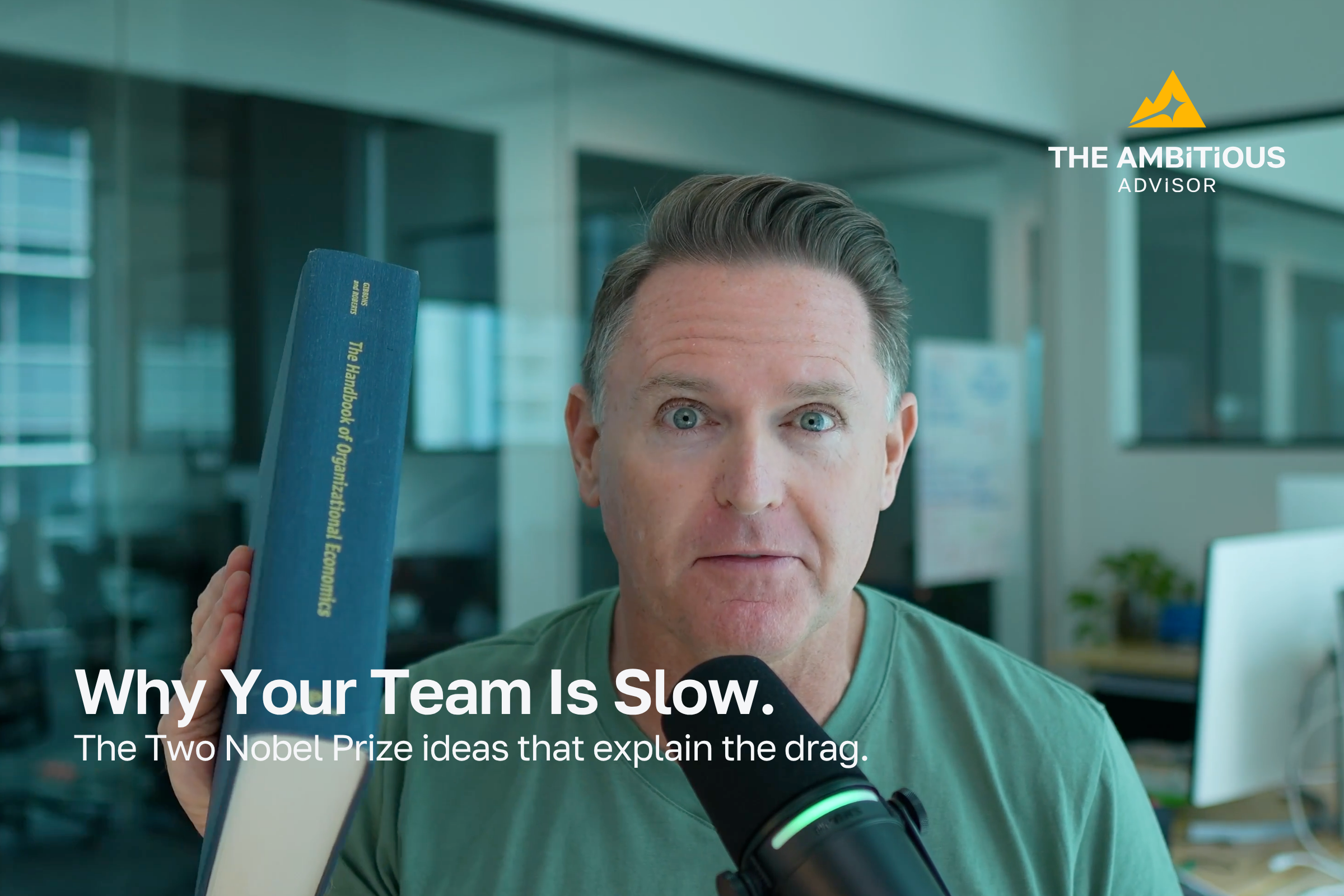
I have been sitting with one of my favourite books, The Handbook of Organizational Economics, published in 2013 and still the densest thousand pages on my shelf, and two concepts from that field explain nearly everything leaders tell me about why their organizations underperform: incomplete contracts and the revelation principle.
What is an incomplete contract?
An incomplete contract is any agreement that cannot specify what happens in every future scenario. In economic theory, this is a mathematical certainty rather than a drafting failure. The concept, for which Oliver Hart shared the 2016 Nobel Prize in Economics, holds that the rights and responsibilities of contracting parties can never be fully stated for all eventualities, because not all eventualities can be foreseen.
Now substitute "strategic plan" for "contract" and the problem in your organization comes into focus. Every strategy, every roadmap, every operating plan is an incomplete contract. It cannot pre-specify every future decision, every market shift, every required human behaviour.
Nobody's 2021 plan factored in what AI would do to their industry by 2026. Nobody's supply chain model held up through COVID or the disruptions in the Strait of Hormuz.
Yet organizations spend immense resources treating the plan as if it were complete. I call this the strategy fallacy: the belief that the decisions in the deck are fixed, binary, and settled, and that execution is simply the act of carrying them out.
Jeff Bezos distinguishes between one-way and two-way door decisions. Most strategic plans are built on the quiet hypothesis that everything inside them is a one-way door. We made the call. Now we go.
Here is what the theory tells us instead. A contract that cannot specify what the parties should do in every future eventuality must instead specify who has the right to decide when the parties cannot agree. Because the plan is incomplete, human behaviour has to fill the unwritten gaps when the uncertain arrives.
What this means for leaders and teams. Picture a leadership team that signs off on a plan to grow through adjacent markets. Six months in, a competitor collapses and an acquisition opportunity appears that the plan never contemplated.
The sales leader reads the plan as licence to pursue it. The CFO reads the same plan as a mandate to protect the balance sheet. The head of product waits for guidance that never comes, because everyone assumes someone else holds the call. Nothing in the document is wrong. The document is simply silent, and three capable executives fill the silence three different ways.
Whether those gaps get filled with fast, decisive action or with hesitation and defensive bureaucracy depends entirely on the team's shared conviction. When a team lacks conviction around the core principles, the same gap produces five interpretations moving at five speeds.
What is the revelation principle?
The revelation principle comes from mechanism design, the branch of economics concerned with building systems that produce the outcomes you actually want. Roger Myerson's work on the principle, part of the mechanism design foundations recognised with the 2007 Nobel Prize, showed how to structure the rules of a system so that people find it in their own interest to reveal their private information truthfully.
The system performs at its peak only when every participant tells the truth about what they know, instantly and without filtering. When a team can look at raw data, admit execution risks, and report constraints without self-preservation getting in the way, speed multiplies. Truth-telling is the ultimate operational accelerator.
What this means for leaders and teams. Picture the monthly business review. A product leader knows the flagship launch will slip six weeks. The dashboard still shows green, and she reports that the programme is on track with some risks being managed, because saying the true date out loud in front of her peers feels like an admission of failure.
Marketing keeps building toward a launch date that no longer exists. Sales keeps promising it to customers. The truth arrives eventually, as it always does, but it arrives late, expensive, and wearing the costume of a surprise.
Every leadership team has a version of this meeting. The question is only how much of reality survives the journey to the table.
So we have two principles. The first says you cannot plan for everything, and the gaps must be filled by people. The second says the machine only runs at full speed when those people share everything they know. The issue is the way these concepts play out in teams everywhere.
Why the two principles collide inside real organizations
Drop human beings, with feelings and egos and reputations to protect, into a complex enterprise, and the two principles crash into each other. The enterprise does not need to be large for this to happen. Twenty people will do it as reliably as twenty thousand.
The future is ambiguous because the contract is incomplete. Ambiguity threatens status, so people protect themselves. And the protective response is a direct violation of the revelation principle: leaders filter and sanitise reality.
Team members mask an execution risk or stay silent in the meeting because corporate politeness feels safer than a hard conversation. People baseline their forecasts on what they can safely achieve rather than what is genuinely possible, because hitting their own metric matters more to them than the enterprise mission.
The research bears this out in stark terms. Work by James Detert and Amy Edmondson found that 85 percent of employees have withheld important information from their manager because they feared the consequences of speaking up.
This is where the symptoms leaders describe to me come from. Consider each one against the mechanics.
Decisions take too long because nobody wrote down who holds the decision right when the plan runs out, so every ambiguous call gets escalated, socialised, and revisited. McKinsey's research found decisions routinely bubble up to where they do not belong, wasting time and effort and often producing poorer outcomes.
Decisions resurface because they were never truly made. When people withhold their real objections in the room, the objection does not disappear. It goes underground and returns as relitigation, slow-walking, or quiet non-compliance. The meeting produced politeness, and politeness is not agreement.
There is no ownership because ownership of an ambiguous outcome is personally dangerous in a low-truth environment. If admitting a risk gets punished, the rational move is to keep your name off the decision. What looks like a character deficit in your team is a rational response to the incentives around them.
And inertia is what all of this costs. Bain's decade-long research programme across more than 1,000 companies found that decision effectiveness and financial performance correlate at a 95 percent confidence level, in every industry and at every company size they studied, and that top-quintile companies on decisions generate total shareholder returns nearly six percentage points higher than everyone else.
The evidence also demolishes the excuse most teams reach for. McKinsey found that organizations that decide quickly are twice as likely to make high-quality decisions. Slowness does not buy rigour. It buys drag.
Can you force people to tell the truth?
Some organizations have tried to solve this structurally, and the most famous experiment is instructive. Ray Dalio built Bridgewater into one of the largest hedge funds in the world partly by codifying radical transparency into its operating principles.
He was prescient enough to see that incomplete contracts and hidden information would systematically destroy execution, and he built tools to force the truth out, including the Dot Collector, which let employees rate one another's contributions in real time during meetings.
It worked, to a degree. Information that would otherwise stay hidden surfaced. But the boundaries of the experiment revealed the more important lesson.
When transparency is enforced through rigid algorithmic compliance, people comply out of necessity rather than shared belief. Compliance and commitment are different states, and only one of them produces momentum. The system optimised the tracking of mistakes. It could not create the alignment of a genuinely healthy team.
Will agentic AI fix the execution bottleneck?
Partly, and the part it fixes is revealing. Agentic AI systems, which autonomously execute and optimise end-to-end processes, hold one profound structural advantage over any human executive.
They carry zero psychological liabilities. An AI agent has no ego, no shame, no internal politics, and no reputation to protect through the next quarterly review. It satisfies the revelation principle flawlessly because it cannot choose to hold information back, and it will not sandbag a goal so the goal can be safely hit. It exposes the unvarnished truth of a process constraint instantly.
That makes agentic AI a serious answer for the automated workflows where incomplete contracts create gaps a machine can fill. But it leaves senior leaders with a paradox worth sitting with.
AI can give you perfect data symmetry. It cannot give you conviction, the deep shared certainty that a bold future is worth building. It can optimise a trajectory. It cannot supply the audacity to break convention entirely. It solves the information half of the problem and leaves the human half untouched.
The work that remains
The economics has been clear for decades. You cannot write a complete plan, so your team's behaviour in the gaps determines your performance, and that behaviour is governed by whether telling the truth is safe. Algorithms can remove some of the human drag, and where they can, let them.
But moving an organization from its status quo to phenomenal results still requires a team where truth-telling is a baseline habit rather than an enforced rule, where decisions carry named owners, and where conviction fills the gaps the plan could never cover.
This is the work I do with The Ambition Playbook™. When we meet with leadership teams, we work on these competing dynamics directly, at the top table first, and then we equip the team to drive the same honesty deeper into the organization.
There is no workaround. Resolution comes only when a team has the courage to acknowledge these issues, own them, and act against them, and that takes intentionality and focus.
What makes the work hold is that we understand the science underneath the symptoms. We are not treating slow decisions with a meeting format or a facilitation trick. We are addressing the root cause, because we know precisely what it is.
If the symptoms in this article sound like your Monday, the plan is unlikely to be your problem. The gaps in the plan are, and closing them is the work.
Frequently asked questions
What is an incomplete contract in business terms?
It is any plan or agreement that cannot specify what should happen in every future scenario. Every strategic plan is one, which means human judgement and team dynamics decide what happens when reality departs from the deck.
Why do decisions keep getting revisited in my organization?
Usually because the original decision was never genuinely made. When people withhold their real objections in the meeting, the disagreement survives the meeting and returns as relitigation. The fix is a decision process where dissent surfaces before the call, and a named owner after it.
Does slowing down produce better decisions?
The evidence says the opposite. McKinsey found a strong correlation between fast decisions and high-quality ones, because the disciplines that create speed, namely clear ownership and honest information, also create quality.
Can AI solve poor team execution?
It can remove the information bottleneck in automated workflows because it has no incentive to hide anything. It cannot create the conviction, ownership, and audacity that move a leadership team, which remain human work.