You Already Know Who Should Not Be on Your Team
The signals are already in front of you. Leadership is choosing to act on what you can see.
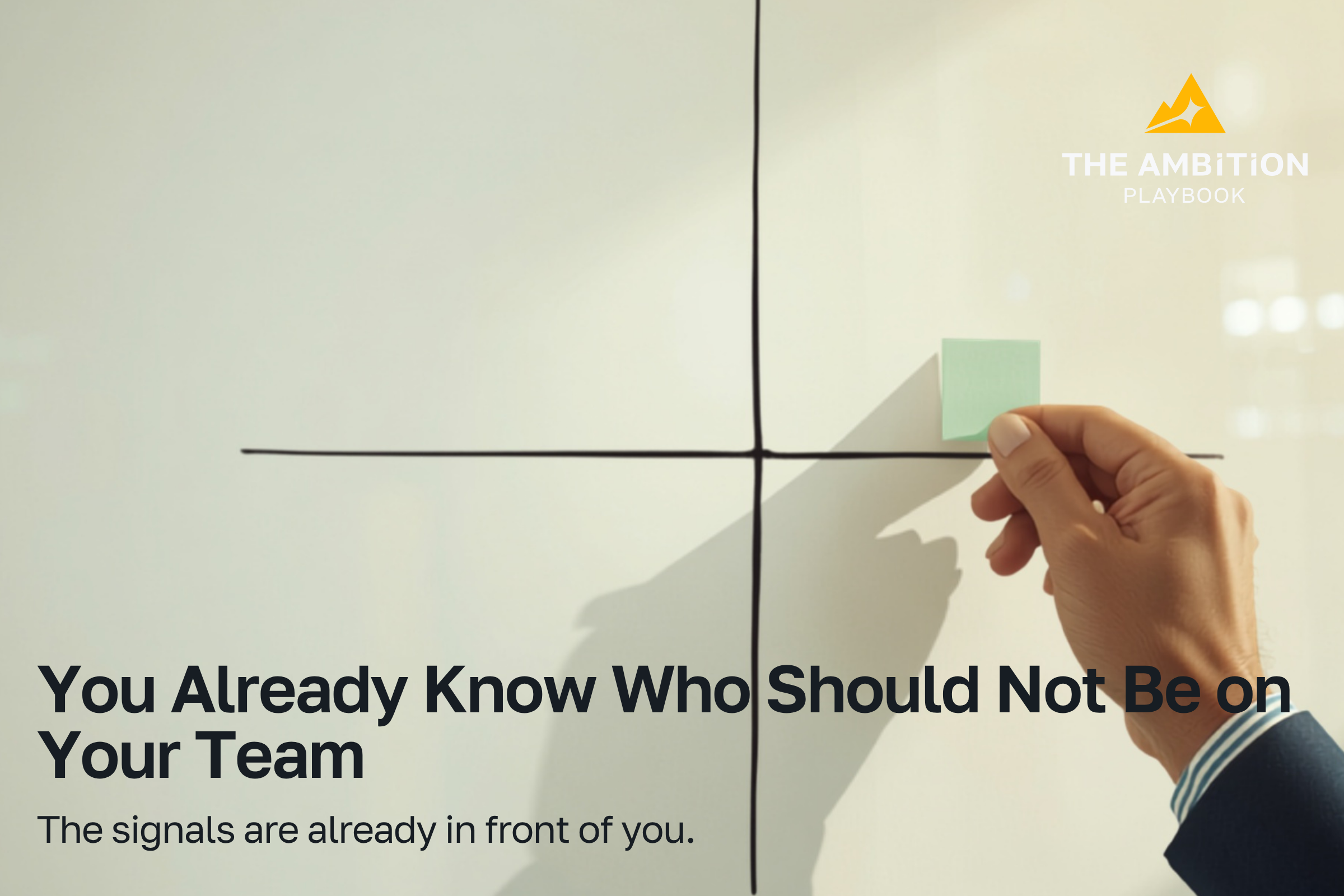
The Wall Street Journal recently published a 2x2 of the fan experience that is both fun and, I suspect, directionally true. I cannot vouch for the rigour of the analysis, but I am sure it captures something real. At one end, the fans having the party of their lives. “Where’s the beer, Boston?” At the other, the ones who would rather be home, right now.
What makes a 2x2 like this work is the move at the heart of it. Take two otherwise unrelated continuums, set them against each other, and suddenly you can hold more than one dimension in view at once. That it is visual only adds to the appeal. For most of us a 2x2 is quicker to grasp than the same data buried in a spreadsheet.
I would suggest the same trick applies to almost every team we work with.
Most teams have made a far bigger production of team performance than it needs to be. Surveys. Engagement scores. Sentiment dashboards. None of it is wrong, exactly, but it tends to crowd out the thing leaders already know in their gut. It does not have to be this way.
Take two dimensions: performance and happiness. Happy people generally perform better, and contribute more richly, than miserable ones. The logic holds on the surface, which is what makes it worth pursuing. Two simple axes, considered together, will tell you more than most of the instruments you have been sold.
On performance
If you tolerate underperformance from anyone, happy or miserable, you set a dangerous precedent. You signal to the entire team that underperformance is acceptable. From there it is a fast ride to the bottom, and a hard one to reverse.
Your good people watch you tolerate it and grow disillusioned. Your underperformers notice there is no real reason to improve, and so they coast. That is how an insidious, low-effort culture takes hold. A downward spiral, and you are the one who set it in motion.
Not every poor performer is a lost cause. Some are held back by a gap in skill or capability, or by an environment working against them. Where that can be addressed, it should be. But the persistent underperformer, the one given the runway and the support who still does not move, needs to go.
On happiness
Happiness is the harder of the two to measure. From first-hand experience, I can tell you that you feel it long before you can measure it. You can see the people who want to be doing the work they are doing. The ones eager to grow, to learn, to help others, and to enjoy themselves while they are at it. Those are the people I want to build a team with.
So, how is your team doing?
I would wager you can plot every name on this grid in a few minutes. No deep analysis. No survey on sentiment or engagement. Just the honest read of what you are seeing and feeling from your people, right now. That read is more reliable than you give it credit for.
Kudos to the WSJ for the inspiration. Now go and level up your team.